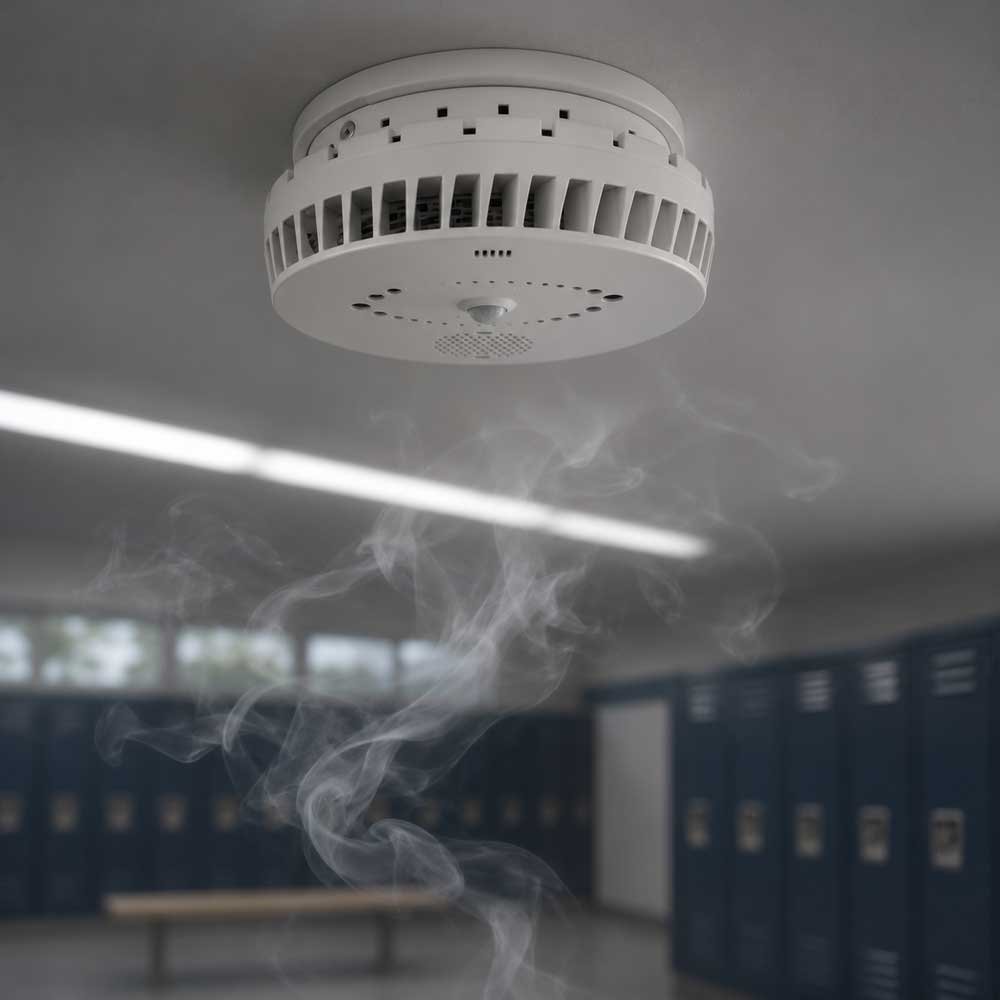
Every campus has blind spots that are blind on purpose. Restrooms, locker rooms, nurse’s offices, and changing areas cannot have cameras, and everyone on campus knows it. That is exactly why they become the places where students vape, fights start, and, in the worst cases, weapons appear. Cameras cover the hallway. Nothing has covered the room behind the door until now.
The HALO Smart Sensor is built for that gap. It is a ceiling-mounted device that detects what is happening in a space through air chemistry and sound patterns, without a camera lens or an audio recording, and alerts staff in real time. Gaynor Telesystems installs HALO as part of our Education Solutions for Northern California K-12 districts and for businesses that need to monitor spaces where video is not an option. Here is what it catches that a camera never will.
1. Vaping and THC in the restroom
Youth vaping has declined from its peak, but it has not disappeared. The FDA’s 2025 National Youth Tobacco Survey found that 5.2 percent of middle and high school students currently use e-cigarettes, and roughly 2 million students use some tobacco product. On a 1,000-student campus, that is dozens of students, and almost all of that activity happens in the one place administrators cannot see.
HALO detects the airborne signature of vape aerosol, including nicotine and THC, and distinguishes it from ordinary humidity or aerosol deodorant. When a threshold is crossed, it sends an alert to the office and can automatically pull up the nearest hallway camera so staff can see who exited the restroom in the last 30 seconds. Districts we work with treat this less as “catching kids” and more as a deterrent: once students learn the sensor is real, the restroom stops being the vape lounge.
2. Gunshots and aggression, by sound pattern
HALO’s audio analytics recognize the acoustic pattern and frequency of a gunshot and the abnormal noise profile of shouting or a fight, and it does this without recording any audio. The sensor listens for patterns, not words. A gunshot detected in a locker room can feed the same emergency lockdown workflow as a camera-based detection, which means the response starts even though no camera ever saw the weapon.
Aggression detection is the quieter win. Fights in restrooms and locker rooms often go unreported until someone is hurt. A raised-voice alert that brings a staff member to the door in 30 seconds prevents most of them.
3. Spoken keywords for help
The HALO 3C supports five programmable spoken keyword triggers. A student or staff member who says the designated phrase, for example “Help, HALO,” sends an alert with the sensor’s location. It turns every monitored room into a room with a panic button, which pairs naturally with the wearable and desk-phone options we cover in Why Every Front Desk and Classroom Needs a Panic Button in 2026.
4. Air quality and chemical hazards
This is the capability that surprises facilities directors. HALO continuously measures carbon monoxide, particulate matter (PM1 through PM10), volatile organic compounds, and nitrogen dioxide. It has caught chemistry-lab leaks, idling-bus exhaust drifting into a classroom wing, and cleaning-chemical misuse in custodial closets. In manufacturing and government facilities, the same sensor provides indoor air quality documentation that a camera simply cannot produce.
5. Occupancy and tamper
The 3C-PC model adds people counting, so a district can see how many students are in a restroom at once, flag crowding that usually precedes a fight, and confirm compliance with occupancy limits. Every HALO also reports tamper attempts, because the first thing a determined student tries is covering the sensor with a plastic bag.
Why “no camera, no recording” is the feature, not the limitation
Parents and school boards rightly object to surveillance in private spaces. HALO answers that objection cleanly: there is no lens, no microphone recording, and no stored audio. The device reports events, not content. When Gaynor presents HALO at board meetings, that single point usually resolves the privacy conversation, and it is why HALO sensors are increasingly written into Comprehensive School Safety Plans alongside cameras rather than in competition with them.
Sensors and cameras work better together
None of this replaces video. The strongest deployments pair HALO with the cloud cameras covering the corridor outside each monitored room. HALO publishes integration guides for Avigilon and works with Verkada and other major video platforms, so a vape or aggression alert can bookmark the hallway footage automatically. Staff get the who from the camera and the what from the sensor.
Gaynor designs the two layers as one system. Our Corning Elementary School District project showed how cameras alone all but eliminated graffiti and vandalism at two campuses; adding sensors extends that deterrent into the rooms cameras cannot enter. And because HALO runs on a single PoE cable, installation on an existing network is a half-day job per building, not a construction project.
Where to install HALO first
Districts rarely need a sensor in every room. Based on our Northern California deployments, the highest-value locations are:
• Student restrooms, especially the ones farthest from the office. One sensor covers roughly 144 square feet for vape detection and up to 1,963 square feet for sound and air-quality events, so a typical restroom needs one unit.
• Locker rooms and changing areas, where fights and vaping cluster before and after PE.
• Science labs and custodial closets, for chemical and CO monitoring.
• Stairwells and dead-end corridors that cameras cover poorly and where aggression detection adds the most.
For businesses, the equivalent list is employee restrooms, break rooms, warehouse corners, and any area where a lone worker might need to call for help by voice.
Frequently asked questions
Does HALO record video or audio?
No. There is no camera in the device and no audio is stored. It analyzes sound patterns and air chemistry in real time and transmits alerts only.
How many false alerts should we expect?
Sensitivity is adjustable per sensor, and Gaynor tunes thresholds during the first two weeks of a deployment. Aerosol deodorant and steam are the most common early triggers, and both are filtered once the baseline is set.
Can HALO be funded like cameras?
Yes. HALO is typically eligible under the same COPS School Violence Prevention grants and state contracts as camera and access control projects, and Gaynor’s CMAS approval simplifies procurement for California public agencies.
Who monitors the alerts?
Alerts route to whoever you choose: front office, campus supervisors, SRO, or district security, on desk phones, mobile, or the same dashboard used for emergency notification. Gaynor provides 24/7/365 support at (877) 429-6671 and a remote support portal for changes after installation.
Cover the rooms your cameras can’t
If your safety plan covers hallways but not restrooms, it has a hole in it, and students know exactly where. Request a quote or contact Gaynor Telesystems for a site assessment. We will tell you how many sensors you actually need, where they go, and how they connect to the security systems you already have.